
Teams | Collaboration | Customer Service | Project Management

7 CI/CD Security Best Practices for Agile Teams

Continuous integration and continuous deployment, commonly abbreviated as CI/CD, are quickly becoming standard practices in many software development organizations, as underscored by the tech giant Amazon. A recent State of DevOps Report states that Amazon firmly adopts CI/CD, with a median of 23,000 deploys per day. It translates to a deployment every three seconds!

10 Agile Collaboration Tools In 2025

Managing projects in 2025 is no longer just about assigning tasks and hoping deadlines are met. Small teams and businesses need tools that adapt quickly, provide real-time visibility, and keep collaboration simple. Agile collaboration tools make this possible by bringing sprints, Kanban boards, task tracking, and progress reports together in one place, along with milestone tracking to help you track project progress at every stage.

What is Agile methodology: A Beginner's Guide

Managing modern projects is a complicated thing to do. According to experts, modern projects need modern management approaches. Simply put, the Agile methodology is one of them. Furthermore, it is not the only option. However, given today’s work world scenario, it is one of the best options for managing projects. Techniques such as waterfall and others have more chances of failing when it comes to managing modern complex projects.

Kanban vs Scrum vs Agile vs waterfall: What's the difference?

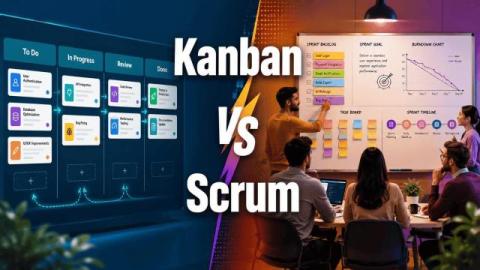
If you’re not sure which project management methodology or framework will be the best to manage your team, we’re here to help. Learn everything about Kanban, Scrum, Agile, and waterfall—what they stand for, how to use them, and the benefits and drawbacks. We’ll also explore key comparisons, such as Kanban vs Scrum and Agile vs waterfall, to help you identify the right fit for your cross-functional team. Waterfall. Agile. Kanban. Scrum.

14 best Agile project management tools to use in 2025 and beyond

Change likes to keep me on my toes, so I rely on agile project management software that's nimble enough to roll with every plot twist. I've learned the hard way that slapping an "Agile" sticker on a slow, click-heavy platform is like adding racing stripes to a bicycle - it feels faster, yet you're pedalling just as hard. When priorities shuffle or a sprint needs resizing, I want to make the changes and keep going - no extra hoops, no head-scratching.

Enhancing Agile Workflows with Time Tracking

Agile teams thrive on speed, flexibility, and continuous improvement—but without clear visibility into how time is spent, even the best processes can falter. Challenges like untracked development hours, mismatched sprint estimations, and vague reporting can seriously impact productivity and delivery timelines. Time tracking fuels continuous improvement by making team performance measurable.

Agile project planning made simple: A step-by-step guide

I spent weeks planning the perfect content campaign. Blog posts, social media, and emails were all scheduled and ready to go. Then, out of nowhere, a competitor released a big campaign of their own, and my team needed me to shift gears immediately. As I tried to reorganize tasks, our design team was pulled onto a different project, causing a delay in the graphics I needed. Quickly, my plan stopped making sense. That’s when I truly understood the benefits of agile project planning.

Agile visual management: How to stay aligned and efficient as an Agile team

Successful Agile projects rely on clarity and collaboration between team members — so to facilitate planning, execution, and retrospectives, product teams assign roles and responsibilities and use structured Scrum events. Teams also practice Agile visual management, a principle that uses visual tools to further improve Agile workflow efficiencies and alignment. Below, we’ll explore the concept of Agile visual management, and the tools behind it.

Almost half of all Agile transformations fail: Here's how to overcome your biggest hurdles

Agile transformation is the process of adopting Agile methodologies and principles across an organization to enable stronger adaptability, collaboration, and more efficient work processes. Organizations go through this process to deliver better products faster, and create more value for the company and their customers. Unfortunately, while the benefits seem clear, according to the 17th Annual State of Agile Report, an alarming 47% of Agile transformations fail. The question is, why?

Toxic productivity is no good-here's how to stop it.

Toxic productivity is more prevalent than ever, and it’s hurting our physical and mental health. In this article, we outline six concrete actions you can take to regain balance and break the cycle of toxic productivity for good. Forty percent of workers think burnout is an inevitable part of success. But the truth is, brute-force productivity isn’t sustainable in the long run.