Teams | Collaboration | Customer Service | Project Management

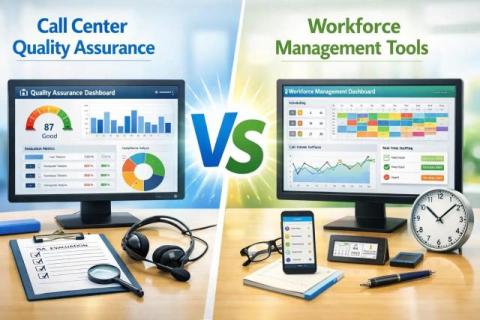
Call Center Quality Assurance vs. Workforce Management Tools

Running a call center is like juggling. On one hand is quality - are agents handling calls well? On the other hand, is capacity - are there enough agents available to handle those calls at all? One wrong move and your customer experience suffers. That is the core tension behind the debate over call center Quality Assurance (QA) tools versus Workforce Management (WFM) tools. Both are essential. But they solve very different problems. Confusion about what they do can be a costly error for your call center.

What is the difference between workforce analytics and HR analytics?

HR analytics focuses on people-related data, such as hiring, retention, and engagement, and typically uses historical reports to guide business strategy. Workforce analytics focuses on how work gets done, using real-time data on productivity, workload, and workflows to help leaders optimize decisions and act faster at an operational level. The key difference is simple.

Top 10 Best Work Management Software For 2026

Work management software is a digital platform that helps teams plan, assign, track, and complete both project-based and day-to-day work — all from one centralized place. A robust work management system typically includes task management, time tracking, reporting, team collaboration, and workflow automation. Written by: Sagar Modi.

Top Management Strategies That Drive Productivity in 2026

In 2026, businesses face a complex mix of remote and hybrid work, multigenerational teams, AI adoption, and growing demands for flexibility, purpose, and autonomy. In this environment, traditional management models built on rigid hierarchies and close supervision no longer deliver strong results. To remain competitive, organizations must adopt strategies that boost productivity, strengthen engagement, and empower employees to perform at their best.

Why Your Business Needs Shift Management Software in 2025

In the modern workplace, managing employee shifts efficiently is a critical challenge for businesses of all sizes. With increasingly complex schedules, remote teams, and evolving labor laws, traditional manual scheduling methods are no longer effective or sustainable. This is where shift management software plays a transformative role.

All You Need to Know About Workload Management in 2025

Is workload management getting too complex for you in 2025? You are not alone. In today’s work world, involving modern technology, it is essential to properly distribute workloads across your various departments, teams, and employees. Otherwise, you can expect stress, burnout, and everything that comes in between in at least 40-50% of your employees. Managing employee workload is more than just managing tasks, resources, and projects.

9 Workload Management Strategies to Balance Team Capacity

Workload management is the process of assigning projects and tasks across your team based on capacity, skills, and priorities. The goal is to maximize team members’ billable availability and experience levels, keeping them in a 70-80% utilization range. If you give team members too much work, they’re prone to burnout and making mistakes while rushing to meet deadlines. And underutilized staff become disengaged and represent lost opportunities to bring in revenue.

Why workforce management analytics is key to smart decision-making

Are staffing issues, employee turnover, or high labor costs draining your business? Imagine running a business without a clear way to manage your employees. Without workforce management analytics, you never know how many employees will show up or when you’ll be short-staffed. Some days, you have too many people on duty, wasting money. On other days, you don’t have enough, causing stress, delays, and unhappy customers.