
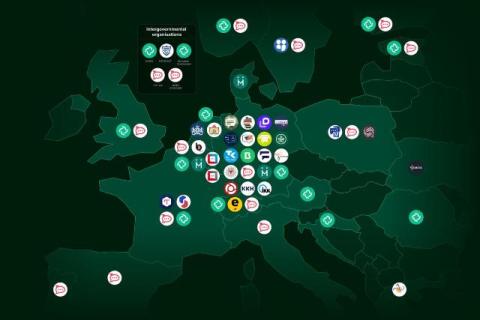
Europe’s reliance on proprietary tech giants like Microsoft, Google, and Amazon for critical software and data services presents a growing concern to European enterprise leaders. Decision-makers are increasingly asking a practical question: Can we still rely on U.S. technology for Europe’s most sensitive data and collaboration?
European enterprises have built much of their digital infrastructure on U.S. platforms such as Microsoft 365 or AWS. These tools power everyday collaboration and productivity, but they also expose organizations to legal, operational, and reputational risks that are often underestimated. As Europe tightens its regulatory frameworks around digital sovereignty, GDPR, NIS2, and DORA, this dependency on foreign infrastructure is no longer just a compliance issue.
When did you last go through many messages to find one important piece of information? Or tried recalling which app your team likes for chatting? This is quite common, and the fact is, that not all communication tools are created equal. While the goals of Slack and Glue is similar with regard to team communications, they go about doing things in very different ways. Slack is a full-on, feature-rich experience suited to larger teams juggling several different workflows at once.
At Time Doctor, we believe that trust begins with transparency. Every insight we provide depends on the confidence that customer data is protected at all times. This month, that commitment was officially recognized, strengthening our dedication to security, privacy, and trust. We’re proud to share that Time Doctor has earned a major compliance milestone.
As an AWS Ambassador candidate and Solutions Architect at Miro, I spend a lot of time thinking about how AI should fit into architecture workflows. In this guide, I’ll share what I’ve learned about using AI to enhance, not replace, the human expertise that makes or breaks cloud infrastructure decisions.
Sure, each division in your organization has unique plus points, and even the work itself is varied. However, only when they interconnect will you achieve success. When departments are spread out, it’s challenging or even impossible to reach the right resource quickly during times of urgency. Plus, there is also a lack of strong collaboration, and sharing important updates breaks the workflow as well. So, what you require is a robust and scalable ERP system.
Measuring employee productivity is a critical part of today’s competitive business landscape. It’s a tool that empowers managers and business leaders to optimize growth cycles, manage performance culture during stressed periods, and understand how effectively their employees are working. Providing a roadmap to improve performance also empowers managers to enhance their performance management skills.
You already know how important employee engagement and motivation are for your business, its productivity, and profitability. A straightforward, interesting, and effective strategy for this is job rotation. When you make employees consistently switch between roles, you not only increase motivation, engagement, and retention rates, but your workers also become more adaptable.
As your business grows, scaling your B2B customer support team becomes more than a goal—it’s a strategic necessity. Support leaders need to balance speed, personalization, and cost efficiency without sacrificing quality. According to McKinsey, companies that combine automation with smart process design can increase customer satisfaction by 20% and reduce support costs by up to 30%.