
Teams | Collaboration | Customer Service | Project Management

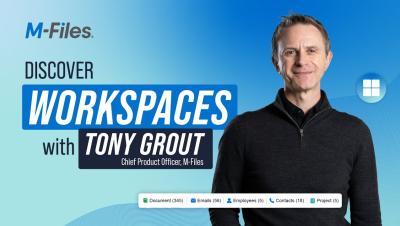
M Files Workspaces by Tony Grout

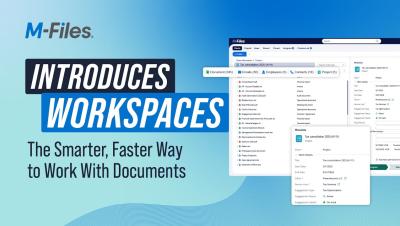
Unlock the Power of Context-First Document Management with a platform that works for you! M-Files Workspaces answers the need to encapsulate business processes and applications inside the user experience. It's one single pane of glass that lets you access your project overviews, clients or accounts associated with that project, the team members involved and all the related documents (contracts, proposals...).

Workspaces: Context-First Document Management

Today we're diving into M-Files Workspaces, a breakthrough in how businesses manage documents, projects, and processes. Joining us is Tony Grout, Chief Product Officer at M-Files, who shares what makes Workspaces a game-changer for knowledge workers and why it represents the next evolution of document management.

Introducing M Files Workspaces: A Powerful New Way to Experience Context-First Document Management

Introducing M-Files Workspaces—the cutting-edge, context-first document management solution engineered to empower businesses with unified access to documents, projects, and stakeholders in a single, intuitive role-based workspace. Harnessing the power of M-Files’ context-first architecture and advanced AI engine Aino, Workspaces transforms document management by simplifying navigation, providing instant access to relevant content, and offering complete visibility into the user’s workflow context.

How to Create Views in M-Files

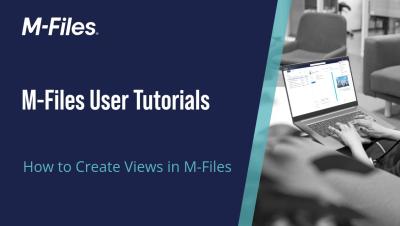
In M-Files, documents and other objects can be categorized into different views according to their metadata. Creating views is largely based on specifying the metadata used for searching and categorizing documents. Views allow you to save frequently used searches and define grouping levels. For information about searching for documents, refer to Searching. Other Helpful Resources.

ECM for Compliance, Security, and Governance

Managing information is no longer only about efficiency. Regulations, audits, and privacy laws require organizations to prove they control their content. Enterprise Content Management (ECM) supports compliance and governance by applying consistent rules for how documents are stored, accessed, and retained. It gives businesses both the security to protect sensitive data and the structure to meet regulatory demands.

Enterprise Content Management: Benefits and ROI

Organizations generate a constant flow of information: contracts, invoices, HR records, emails, designs, and more. Without structure, this content gets scattered across inboxes, desktops, and shared drives. Enterprise Content Management (ECM) brings order by managing content from creation through retention. The result is measurable business value.

What Is Enterprise Content Management (ECM)?

Enterprise Content Management (ECM) helps organizations capture, organize, store, and secure business content. It takes documents, emails, images, and records out of scattered folders, inboxes, and paper files, and brings them into a single controlled system. With ECM, information is searchable, secure, and accessible to the right people at the right time. The result is better efficiency, lower risk, and more consistent operations.