


|
By Luis Hernandez
Keep your Zendesk plan and give your team a live view of what needs attention. Geckoboard connects directly to Zendesk and puts queue size, response times and team performance on a shared dashboard. See queues building and response times slipping while there’s still time to act. Your team gets the numbers to respond, and you can stop being the person who has to spot every problem.
|
By Jude Kriwald
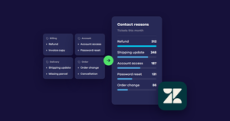
Learn how to merge conditional ticket fields into one Explore attribute so you can report on every contact reason in a single view. Zendesk Analytics (formerly Explore) is powerful, but one area where it falls short is in handling conditional ticket fields with any ease. Many teams use these fields to capture detailed contact reasons under different parent categories.
|
By Jude Kriwald
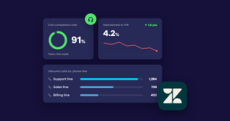
Go beyond Zendesk Talk’s default reporting with five custom metrics (and one essential attribute) that reveal what’s really happening on your voice channel. Zendesk Voice (previously Talk) comes with a range of built-in reports, but most teams quickly find they need more flexibility as they try to drill into what’s really going on. The default metrics are often too broad to give real insight into what is happening in any meaningful way that can be actioned.

|
By Paul Joyce
With AI assistants like Claude and ChatGPT becoming more deeply integrated into knowledge work I wanted to run a like-for-like comparison in a competency close to my heart: data analysis.
|
By Tom Randle
There are three different things people mean by “Zendesk MCP”. Before comparing the options, it’s worth separating out these different use cases.

|
By Sam Gane
The advice says trust your team and delegate more. Here's why that rarely sticks on its own, and what tends to work better. If you've ever promised yourself you'd give someone room to run with a project, then found yourself messaging them for an update by the end of the same day, you already know the loop. You hand over the work with the best intentions. A day goes quiet, you start wondering whether it's on track or quietly going sideways, and before long you've asked for a status.

|
By Sam Gane
It's a familiar scramble. "The investor needs X report!", "The CEO wants to see how Y is doing!" Some poor soul has to rush around to pull all the requested data and deliver it to senior leadership, pronto. This usually means dropping everything else and spending an afternoon gathering data. Often by the time the report is viewed, the data is stale and leadership is left with an outdated picture of performance. Alexandre Naudin, Service Manager at Spash, described this well.

|
By Tom Randle
More than a sales vibe. When sales leaders come to us early in their journey, they often mention wanting to create more of a “sales vibe” or build a stronger “sales culture”. The problem is, vibe and culture don’t cut through when you’re asking a hard-nosed CFO for budget. And rightly so. The good news, and slightly ironically, is that those sales leaders are usually massively underselling what they’re trying to achieve.
|
By Luis Hernandez
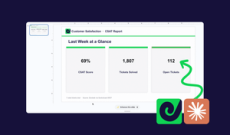
Picture this: it's Monday morning, town hall is at 2 pm, and someone has sent the usual calendar reminder: "Don't forget to update the weekly support deck!" You open the slide, look at last week's numbers still sitting there, and start the ritual. Open Zendesk. Find the right report. Check the date filter. Copy the number. Switch to Slides. Find the right text box. Paste. Repeat fifteen times. Silently wish you were somewhere else. You tried delegating it to an intern once.
|
By Tom Randle
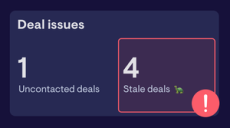
There are few things more frustrating for RevOps and sales leaders than poor-quality CRM data and deals that haven’t been updated properly. What makes it especially annoying is that it’s not a problem you can fix once. It needs active maintenance. Without it, standards slip. There’s an entropy to it. It’s also extremely common. We’ve had it in our own small sales team. There are countless Reddit threads on the subject.

|
By Geckoboard
November is peak season for Simba. Graham Paddon explains how the outreach team uses Geckoboard to stay on top of Shopify data - order volume, revenue, pipeline - so nothing falls through during their busiest period.

|
By Geckoboard
At a glance, you know. MTD Training's COO Kelli Grinter explains how dashboards give the sales team a live view of what's winning and what needs attention - and how a bit of personality (celebrity images, anyone?) makes performance tracking something people actually enjoy.

|
By Geckoboard
Salesforce is the source of truth for most sales teams - but its reporting isn't built for non-technical people or for display. Gianluca Sardo, President of The Glasshouse, explains why Geckoboard's simplicity is the point: live data, visible to everyone, driving motivation and sales performance.

|
By Geckoboard
Turn ChatGPT, Claude and other AI assistants into personal data analysts with the Geckoboard Metrics MCP. In this walkthrough, Geckoboard VP of Product Ben Newell explains how the Metrics MCP gives AI tools access to accurate, real-time business metrics, and shows you how to connect your data and get started. Most AI connectors return raw records, such as individual tickets, deals or calls. The AI must then retrieve those records, define the metric and calculate the result every time. This can be slow, token-intensive and inconsistent.

|
By Geckoboard
Ben Newell, Geckoboard's VP of Product, on designing dashboards that focus a team on what matters. A dashboard is there to communicate, so the discipline is choosing the few things worth everyone's attention.

|
By Geckoboard
The strongest signal of product value is when someone brings it with them to the next job. Christopher Ford, now Director of Growth at HappyDoc, has used Geckoboard for five-plus years across multiple companies and roles. He explains why it stays in his toolkit.

|
By Geckoboard
Ben Newell, Geckoboard's VP of Product, on why building your own dashboard with an AI agent looks fast until you need to trust the number. AI has no underlying data model, so getting a metric to come back right, and the same every time, is the hard part. Geckoboard has already done that work.

|
By Geckoboard
Ben Newell, Geckoboard's VP of Product, on how real-time data changes the way a team performs, and the thinking behind how Geckoboard is built.

|
By Geckoboard
Zendesk Explore is powerful - but it wasn't built for live visibility. Kris Parker at Tithe.ly needed data accessible on any device, easy to understand at a glance. With Geckoboard, the team had more insight in minutes than they'd previously had at all.

|
By Geckoboard
Every morning at Simba, the CX team opens the dashboard before anything else. Graham Paddon, Head of CX, explains how real-time workload data shapes their standup, surfaces problems early, and gives managers the insight they need to act - not just observe.
- October 2026 (4)
- September 2026 (4)
- August 2026 (1)
- July 2026 (5)
- June 2026 (10)
- May 2026 (6)
- April 2026 (1)
- March 2026 (3)
- February 2026 (6)
- January 2026 (5)
- December 2025 (6)
- November 2025 (1)
- October 2025 (1)
- September 2025 (9)
- August 2025 (6)
- July 2025 (5)
- June 2025 (2)
- May 2025 (1)
- April 2025 (1)
- March 2025 (2)
- February 2025 (1)
- January 2025 (2)
- November 2024 (2)
- October 2024 (12)
- September 2024 (8)
- August 2024 (4)
- June 2024 (2)
- May 2024 (2)
- April 2024 (4)
- March 2024 (14)
- February 2024 (8)
- January 2024 (16)
- December 2023 (1)
- November 2023 (2)
- October 2023 (9)
- September 2023 (2)
- August 2023 (4)
- July 2023 (3)
- June 2023 (3)
- May 2023 (6)
- April 2023 (4)
- March 2023 (7)
- February 2023 (2)
- January 2023 (4)
- December 2022 (3)
- November 2022 (5)
- October 2022 (5)
- September 2022 (4)
- August 2022 (2)
- July 2022 (5)
- June 2022 (1)
- April 2022 (2)
- March 2022 (1)
- February 2022 (4)
- January 2022 (3)
- December 2021 (3)
- November 2021 (2)
- October 2021 (4)
- September 2021 (3)
- August 2021 (2)
- July 2021 (3)
- June 2021 (3)
- May 2021 (5)
- March 2021 (8)
- February 2021 (6)
- January 2021 (6)
- December 2020 (6)
- November 2020 (3)
- October 2020 (5)
- September 2020 (9)
- August 2020 (6)
- June 2020 (1)
- May 2020 (3)
- April 2020 (1)
- February 2020 (7)
- January 2020 (3)
- October 2019 (6)
- May 2019 (2)
- March 2019 (1)
- October 2018 (3)
- August 2018 (1)
- June 2018 (4)
- May 2018 (2)
- March 2018 (3)
- February 2018 (2)
- January 2018 (1)
- August 2017 (2)
- April 2017 (1)
- September 2016 (1)
- July 2015 (1)
Achieve more together, whatever your business. A TV dashboard ensures your metrics are front of mind for everyone, focusing teams on what matters now to move the company in the right direction.
No distractions. No unnecessary complexity. No room for misinterpretation. Our visualizations are designed with one thing in mind: to make your most important metrics clear and easy-to-understand. Build a TV dashboard in minutes using a drag-and-drop interface that makes setup and visualization changes so simple anyone can do it.
Bring Any Metric Into Geckoboard:
- 60+ pre-built integrations: Pull live metrics from popular business tools into Geckoboard without any technical know-how.
- Powerful Spreadsheet Integration: Effortlessly turn data tracked in a Google Sheet or Excel file into live visualizations.
- Flexible Datasets API: Visualize metrics from databases, in-house systems and third-party software.
A different KPI dashboard, for whatever you do. There’s no ‘one dashboard fits all’ with Geckoboard. Our software makes it really easy for you to tailor TV dashboards for your team.