

Teams | Collaboration | Customer Service | Project Management

Debunking productivity myths: Why top performers really leave?

Many companies focus on productivity metrics that are easy to track, like hours worked, task completion, employee time tracking, or online presence. These numbers create a sense of control, but they rarely reflect how work happens or how teams are feeling. Imagine a team member who consistently hits deadlines, works longer hours, and picks up extra tasks. Their performance looks strong in the system.


Employee monitoring and productivity: Pros and cons

What if you could recover 14 hours a week just by seeing how your team works more clearly? In many workplaces, minor distractions, overlapping tasks, and unclear ownership quietly add up. It’s like running a relay race without knowing when to pass the baton. Everyone is active, but few know exactly where the time is going. According to employee monitoring statistic, teams lose several hours each week due to unclear task ownership and digital distractions.

Free contractor timesheet templates (Word, Excel, PDF)

How many hours are you paying contractors for, without clear proof that they worked? When you rely on spreadsheets or email to track time, even small mistakes or discrepancies can turn into costly payroll errors. That’s why more teams are turning to contractor timesheet templates as a simple, structured way to record work hours. It’s like trying to balance your checkbook using a handwritten time card with smudged numbers.

Top 10 employee accountability software for team performance

Some employees work. Others just appear to. And without real visibility, you can’t always tell the difference. That’s the uncomfortable truth behind remote teams, hybrid setups, and flexible work hours. Work hours get logged. Tasks get checked off. But deadlines slip, priorities shift, and metrics like output and focus start to fade. You’re left guessing. Is someone overwhelmed, disengaged, or just unaccountable?

Employee time clock: Top 12 digital and biometric tools

Are you sure your employees are working when they say they are? It’s a tricky question, but one that can quietly cost your business thousands each month. Without a proper employee time clock, tracking work hours is like guessing how much gas is left in your tank without a fuel gauge. You just hope you’re right. Here’s a quick example. If 50 employees lose just 30 minutes a day, that adds up to more than 1,100 paid hours every month.

Top 10 custom time tracking solutions for businesses

How much money are you losing just because your team forgot to hit “Start”? That one missed click on your time tracker can cost hours. When it happens repeatedly, those hours quietly turn into thousands of dollars slipping from your bottom line. Let’s say your report shows 870 hours for last month, but your team actually worked closer to 1,000 hours. That’s 130 hours missing. At $50 per hour, that’s $6,500 gone, without a single alert. This isn’t just about lost time.

Time tracking compliance: Accuracy vs employee trust

How much will that timesheet mistake cost you? $500, $5,000, or your entire business? It only takes one audit, one complaint, or one overlooked tracking policy to land you in legal trouble under modern labor laws. And the worst part? You probably didn’t even know you broke the rules. Every time your team clocks in, shares location data, or logs work hours through your time tracking software, you’re creating a legal record tied to employee time.

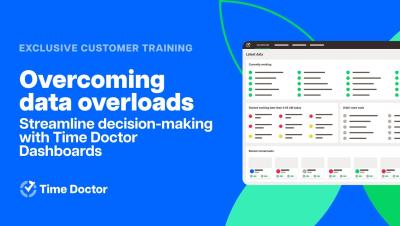
Overcoming data overload: Streamline decision-making with Time Doctor Dashboards

In this webinar, we’ll show you how to tackle the challenge of managing and interpreting vast amounts of workforce data. Time Doctor’s three powerful dashboards—User, Team, and Executive—turn complex information into clear, actionable insights that guide decision-making at every level of your organization.