

Teams | Collaboration | Customer Service | Project Management

Leaving Wrike? 8 alternatives, and which ones still track your margin

Before I joined Teamwork.com, I spent years running delivery in agencies. Most switches I saw started with the right complaint and the wrong cure: Wrike felt heavy, so teams moved somewhere lighter. Adoption jumped, but by the next quarterly review nobody could say which projects had made money. That gap is common. When Teamwork.com's The Sprint to AI report asked senior leaders at client service firms where their tools fall short, 38% cited profitability management.

9 best quoting software tools for services firms that price for margin

The quotes that hurt in my agency years weren't the ones we lost. They were the ones we won, priced fast from a blended rate and a gut feel on hours, then underwater a few weeks into delivery. I work at Teamwork.com now, after nearly a decade in agencies. Back then, quoting lived in spreadsheets next to a basic timer, so no quote ever saw what the team actually cost. Most guides judge quoting software on how fast and how good a quote looks.

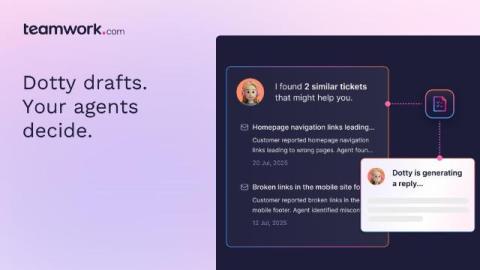
Meet Dotty: the AI Teammate that gets smarter with every ticket

Every ticket your team closes today makes the next one a little easier. That's not a metaphor, it's literally how Dotty works. Dotty is the AI Teammate built into Teamwork Desk. It drafts replies from your help docs and resolved tickets, surfaces the ticket that already solved this exact problem, and summarizes hand-offs so context isn't lost. Your agents review and send: nothing goes out untouched. But the real story isn't any one of those skills. It's what they're building together.

What are Teamwork.com AI credits and how do they work?

Teamwork.com is introducing AI credits. If your first question is “what’s this going to cost me?”, the short answer is that your credits come included with your plan, at no extra cost. Your plan price stays the same, and most of the AI you use day to day doesn’t use credits at all. What changes is how the bigger jobs you hand to AI are covered, like asking Ask AI for a report or having an agent prepare a client update.

How to protect consulting margins when AI shrinks billable hours

A market positioning project that used to take a consulting team four to five weeks now takes two and a half days. That's not a forecast. It's what Michael Nenninger, former EVP of digital consulting at msg, described on a recent episode of the Leaders in Consulting podcast. His team built the work as an AI workflow: around 60 prompts, 15 sub-tasks, and a human checking quality along the way. The host did the math on air: that's 5% to 10% of the effort it used to take.

How to price professional services projects: the four-gate method

I have spent enough time in agencies to know how to price professional services projects badly. The reason most projects lose money has little to do with the pricing model on the proposal. It comes down to two things nobody systematises: what the work truly costs to deliver, and what happens to that cost after the client signs. This guide fixes both with a repeatable four-gate method.

Service business profitability: the five levers that actually move margin

In a services firm, your people are both the product and the cost, so service business profitability gets decided in five places at once. It's what you charge, what you collect, how much capacity you sell, who does the work and what the firm costs to run. This guide runs all five through one worked model. Then a Lever Sensitivity Test shows which lever to pull first, and it's rarely the one leaders reach for.

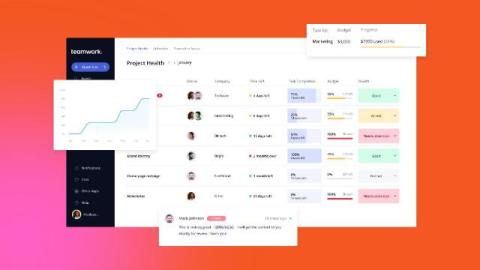
Project profitability analysis: find out why margin moved

A project's margin is an output: it's whatever is left once pricing, staffing, hours, scope and billing have all had their say. Project profitability analysis is the work of tracing that number back to the decisions that produced it. In this guide, I'll walk you through the Five-Lever Margin Bridge and a six-step review that prices each cause in dollars. Then we'll test both on a worked example that reconciles exactly.

How to reduce cost overruns on projects already in flight

Most advice on cost overruns is really advice about the next project. Estimate better, add contingency, tighten the SOW. All true, and none of it helps the project that's 40% delivered and 55% spent right now. This guide is about that project. You'll get a weekly check I call the Burn Gap Triage, three moves for closing the gap, and the delivery habits that stop small leaks becoming write-offs.